bloggy

Charles Goldman in Portland

If you’re in Portland, Oregon over the next couple of months, check out Charles Goldman’s exhibition/performances at the PNCA Feldman Gallery.

Newcountry is an abstract meditation on the changing American landscape. The protagonist is Charles Goldman’s Standard white Toyota pick-up truck — the water, the trees and the air all play their part. Using mundane materials mined from this new American landscape, Goldman will build several site-specific sculptures for the Feldman Gallery + Project Space. Related performances will be held each Friday night at 7:00 pm, beginning on January 21 and running through the remainder of the exhibition.

The work exhibited at PNCA spawns mostly from Goldman’s experiences as a Visiting Faculty in 2003 at University of Oregon in Eugene. The Brooklyn-based artist is currently the Visiting Faculty at California College of Art in San Francisco.

Charles is a good friend of ours, and his web site is the first artist web site I did.

Maybe the NY Times should hire me to help

I rarely read the Public Editor= column in the New York Times, but since Choire mentioned it I read it.

It’s about the dropping of most of the listing pages, and the arrival of Choire’s The Guide. To be honest, I hadn’t really noticed, but apparently a lot of people have.

I think they should hire me to adapt the ArtCat infrastructure for a new listings system.

Some quotation:

Just a few weeks earlier, The Times had tossed the venerable columns of agate type that had filled so many pages of the Arts & Leisure section for so long, with as many as 300 cultural events acknowledged, however briefly, in a single edition. In what seemed to be their place, a single page featured slightly more than 20 cultural items, tucked in and around some less than enlightening photographs, under headlines so opaque as to be incomprehensible. Down the side of the page, in very large type, marched the days of the week. The items aligned next to each described a few events or productions scheduled for those particular days, but in several cases they were events that could also be enjoyed (or endured) on many other days. To many readers, this was not just confusing; it was replacing a symphony with a jingle.

Inside The Times, there were several knocks on the old listings: They were dull. They were so absent critical judgment that readers, said Arts & Leisure editor Jodi Kantor, were “lost in a sea of names and titles.” Culture editor Jonathan Landman believed they were “cryptic and hard to use for all but highly expert arts consumers.” Kantor, Landman and others assert that because much of the information was available elsewhere, the old listings were redundant, and therefore vestigial.

There may be something to these criticisms (I’ll certainly go along with the dullness charge), but each bears the scent of journalistic arrogance. Journalists like to do journalism; they’re much less excited by the compilation of largely uninflected data. The old listings required great care, but they called for neither enterprising reporting nor graceful style nor, really, for critical judgment. Kantor told me that “we find it hard to believe that those listings, so skimpy they didn’t even list prices, created much of an audience for events.” But that “lost in a sea of names and titles” argument is refuted by the results. If the listings didn’t create much of an audience, why are audience-chasing producers so upset that they’d join, or even inspire, an organized protest effort?

Landman’s only-for-experts argument is simply condescending. It also sounds like the view of someone who’s not a terribly avid arts consumer. Sure, the average reader could stumble through much of the listings pages puzzled by references to obscure painters or outré theater companies or little-known dance troupes. But that same “inexpert” reader could open the paper on a Sunday morning, see a reference to a Chopin recital at a church in Murray Hill that afternoon, and extract a very pleasant day from it. Additionally, what Landman imprecisely calls “highly expert arts consumers” are not such rare creatures in New York. If you’ve already made the commitment to peruse the jazz listings, then it’s likely you already know quite a bit about George Coleman and Lou Donaldson and Steve Turre. That doesn’t take an expert; that takes a fan, and this city – cultural capital of the nation – is home to thousands upon thousands of fans.

Then there’s The Guide – well intended, and somewhat improved with each passing week, but nonetheless an ill-conceived failure. Kantor says the range of items included “is a testament to the richness of New York’s cultural life.” But it’s also testament to a narrowing down so severe, and so individualistic, that its arbitrariness is unnerving. I’ve got nothing against Choire Sicha, the author; the enormous range of arts events in New York filtered through the sensibility of a single individual wouldn’t be any more useful if the sensibility was Edmund Wilson’s. Interesting, sure, but it’s simply wrong-headed to represent it as useful. And for a newspaper that considers itself the leader in cultural coverage, “useful” is an admirable goal.

It’s a bit brutal toward Choire’s gig (what did you expect from readers that complain when the Travel section writes too much about hotel rooms under $400 per night?), but I love the part about fans. That’s how James and I describe ourselves. We get recognized by people because we show up at so many galleries and theater events, so when people ask if we’re in the arts, we say, “No, we’re art fans!”

Fresh Tracks at Dance Theater Workshop

My favorite regular event at DTW is Fresh Tracks, as I have said before.

It’s described on the site as:

Created in 1965, Fresh Tracks is Dance Theater Workshop’s longest-running series of new dance and performance. Featuring works by emerging choreographers and performance artists selected through open auditions by a panel that includes artists, producers and critics, the six artists selected possess unusual potential and striking imagination.

Fresh Tracks has helped to identify and launch the careers of such well-known choreographers as Bebe Miller, Molissa Fenley, Bill T. Jones, Wendy Perron, David Parsons, Donald Byrd and Anne Teresa de Keersmaeker, among others.

We went tonight. The performers were Allen Body Group, Felicia Ballos, Jonah Bokaer, Jeremy Laverdure, Daniel Linehan, Yoko Sugimoto and Yuka Kikuchi. We went mostly because we know Felicia Ballos.

For us, the two best performances of the evening were the ones by Daniel Linehan and Felicia. Daniel Linehan’s performance, titled Digested Noise, was a solo choreographed by him, with a (mostly) non-verbal sound accompaniment generated by him as well. There were grunts, hums, clicks, and the occasional word or phrase, such as “Go! Stay!” or what seemed to be a reference to an attack. It was dazzling. Watch for that name. He is a young one, having graduated from the University of Washington in Seattle last spring, and I would expect him to go far.

Felicia Ballos’s work was titled Fragile Lodging. There was supposed to be a video component by Anna Craycroft, but there were technical difficulties and she performed without it. I don’t want to insult anyone, but it felt like a complete work anyway. Her disjointed movements and vague, odd facial expressions (including gum-chewing) had the audience quite enthralled. Her face was so compelling in the performance that I had to remind myself that her body was doing things too and I couldn’t only watch her face.

It repeats tomorrow night (Saturday) at 7:30. It’s the best $20 you’ll spend all weekend.

Thought while at the gym today

  • Nerdy Jewish boy wearing a “Physicians for Social Responsibility” t-shirt: Hot
  • Chelsea boy wearing a silver hoop in each ear, an Armani Exchange baseball cap, and a “Pain is Fear Leaving the Body” t-shirt: Not

Happy Thanksgiving!

It’s the best holiday. It’s about food and family — chosen or biological.

spicy_kumquat_and_cranberry_preserve2.jpg
Spicy Kumquat and Cranberry Preserve — in process

No, of course I’m not cooking. James does all of that!

Crime / Art

It’s embarassing to admit that this is the first time I have read William Gibson’s Neuromancer. Here is my favorite quote so far:

Blank walls, no windows, a single white-painted steel firedoor. The walls were coated with countless layers of white latex paint. Factory space. He knew this kind of room, this kind of building; the tenants would operate in the interzone where art wasn’t quite crime, crime not quite art.

Here is his web page, complete with weblog.

Art, blogging, and intellectual property

charles_L_mee.jpg
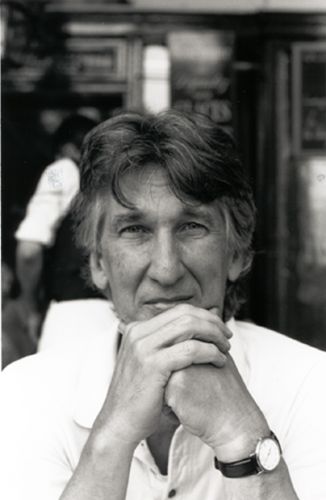
Charles Mee, playwright

James and I attended the Rhizome Blogging and the Arts event tonight. During the discussion, Lisa from CultureKitchen mentioned the concern about intellectual property and just letting art or writing be out there that scares so many artists and writers. I was reminded of the wonderful and generous playwright Charles Mee. His website, called the making project, has the complete texts of his plays. If you wish to perform them as written, or essentially as written, you have to get permission as they are copyrighted. Otherwise, if you want to use elements of them in your own work, they are free. To quote from the site:

Please feel free to take the plays from this website and use them as a resource for your own work: cut them up, rearrange them, rewrite them, throw things out, put things in, do whatever you like with them—don’t just make a few cuts or rewrite a few passages, but pillage the plays and build your own entirely new piece out of the ruins—and then, please, put your own name to the work that results.

But, if you would like to perform the plays essentially or substantially as I have composed them, they are protected by copyright in the versions you read here, and you need to clear performance rights with…

James and I saw him at Wallsé when we were there with friends for one of the Monday night wine dinners (a bargain I might add). We were probably the only people in the place excited to see him. We didn’t react as strongly to seeing Kristen Johnson at the next table…

If you prefer to read his plays via a real book, I recommend History Plays.

P.S. I’m going to turn comments back on for everything but political posts. Those attract too many right-wing idiots finding people to argue with via Google.