bloggy

The Civilians - April 16 benefit

Of course we’ll be there, and I welcome any of my readers to join us. The Civilians are one of my three favorite theatre companies in NYC. The other two are Target Margin and The Wooster Group.

It’s $60 for the whole thing, or $20 for just the after party.

Details:

GRAND HARMONIOUS VAUDEVILLE
Friday, April 16th, 8pm
Ticket price includes a buffet of Chinese appetizers.
Complimentary vodka and tequila cocktails courtesy of Grey Goose and Corazón.
Cash bar for other drinks.

Grand Harmony Restaurant
98 Mott Street (Chinatown, between Canal and Hester)

Featuring
Performances of never-before-seen texts by Civilians Advisors John Guare and Charles L. Mee, Jr.

New renditions of Civilians songs including selections from our upcoming show Nobody’s Lunch.

Tony-Winner Karen Ziemba (Never Gonna Dance, Contact)
Bayne Gibby (HBO’s Out on the Edge)
Mo Rocca (Comedy Central’s “The Daily Show”)
and more to be announced soon.

GRAND HARMONIOUS AFTERPARTY
10pm – Midnight
with dancing and music by DJ Kozmik

Here is the link to the benefit page, including how to get tickets.

I have written about The Civilians quite a bit. If you want to hear what some of their songs sound like, I have some MP3s here.

Queer news = style section

While I’m glad the New York Times is choosing to write about the issues facing transgender people, I am baffled by the placement of the article.

What is an article about transgender college students doing in the Sunday Styles section? No wonder Choire at Gawker refers to his “ritual cleansing” after reading the Sunday Times.

More on our subway adventure

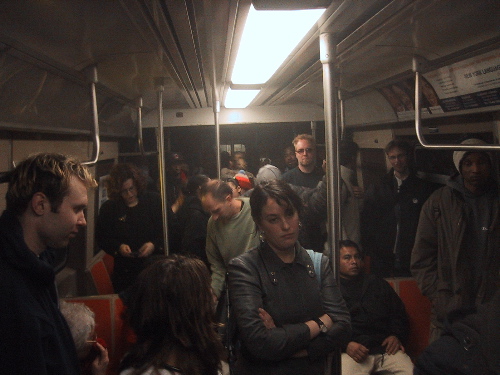
Ray Sanchez has a column in today’s Newsday on our little subway adventure. I think it’s quite good. I never had an experience with the media before where the point I wanted to make actually made it into the article.

If you run out and buy the print version, you get a photo of us.

Column on Haiti

This column from Mark Weisbrot provides some interesting background on the situation in Haiti. A sample:

The latest coup is in many ways a repeat of the military coup that overthrew Aristide in 1991. Although many Americans know that President Clinton sent 20,000 troops to restore Aristide to the presidency in 1994, they do not about Washington’s role prior to that.

The United States, which occupied Haiti militarily from 1915-1934 and had plenty of support for the murderous Duvaliers who ruled the country from 1956-1986, had a problem when Haiti held the first democratic election in its history.

Aristide, a populist priest who preached liberation theology, was elected by a landslide in 1990.  After serving seven months in office, he was overthrown by the military. The officers who led the military coup were, as later reported by the New York Times, on the payroll of the CIA. But the Washington connection did not end there.

A death squad organization known by the French acronym F.R.A.P.H was formed, and murdered at least 3000 of Aristide’s supporters over the next three years. The founder of the organization, Emanuel Constant, stated in an interview on CBS’ 60 minutes that he was paid by the CIA to create and maintain the organization during the dictatorship. He now lives in New York.

Constant’s second in command, convicted murderer Louis-Jodel Chamblain, was one of the leaders of last week’s insurrection. The New York Times report on Tuesday summed up the situation after the coup: "These men, whom Mr. Powell characterized last week as “thugs,” and a few hundred of their followers are for now the domestic face of national security in Haiti.

Theatre non-recommendation

Ugh. We saw Nicky Silver’s Beautiful Child at Vineyard Theatre last night.

I hated it so much I don’t even want to talk about it. If I hadn’t been on the second row I might have walked out.

I was actually angry when I left the theatre. It’s bad enough to see a mess of a play that’s a comedy, but to see an awful play about a child molester is just too much. If I had been The Vineyard, I would have told Nicky, “we’re not producing this one.” It was like bad dinner theatre Albee.

I wonder what Rex Reed thought? He was in the audience.

Headed out to vote for Kucinich

I’m headed out to vote for Dennis Kucinich in the primary. Go read Matt Taibbi on the Congressman from Ohio who actually believes we all deserve health care.

There are a lot of people out there who are inclined to laugh at this candidate. A few do so because they genuinely find him laughable, but most do it because they see him being laughed at in the news media. In this country we generally take our cues about whom we can safely laugh at from the mainstream press, and for the most part we laugh at the weak, the earnest, the sincere, the emotionally vulnerable. We laugh at people who are fat and ugly or who work as temps or at McDonald’s because none of us want to admit that we’re not the ripped six-pack guy on the cover of Men’s Health, or a member of the Sharper Image target market. We’re cowards, afraid of admitting to being who we are, and we laugh at people on the margins to avoid being identified as outsiders by the remorseless center.

It’s the same with politics. Over and over again we have been told, in a million different ways, that a certain kind of idealism is actually childish weakness, and that the only pragmatic way of approaching life upholds force and commerce as the chief engines of social organization. That is why we laugh at people who use words like peace and community but praise as tough, responsible leaders anyone who’s willing to drop the most mother-of-all bombs on defenseless foreign populations. We laugh at a person who uses the word peace for the same reason that we laugh at the person who works as a temp or at McDonald’s: because we’re afraid of being lumped together with him.


I will never forgive America for what Dennis Kucinich went through this year. Because he has had the audacity to call for an end to all wars, to announce plans for the creation of a Department of Peace, to question the very culture of viciousness and intolerance and crass commercialism that rules our public discourse, he has been labeled a lunatic by nearly every “responsible” press organ in this country and cruelly mocked to a degree that no civil society should allow an honorable man to endure. The New Yorker, that revolting beacon of glib, self-satisfied affluence, runs a cartoon showing Kucinich sweeping to victory in a primary held on Mars. The New York Times first angrily demands that he not waste any more of our time, then actually physically disposes of him after the passing of some self-imposed fictional electoral deadline. Even the more genuinely funny and more intelligent people in American public life–I’m thinking particularly of Tony Kornheiser and Michael Wilbon–can’t resist savaging Kucinich whenever they get a chance. All because he’s funny-looking, and because he uses the word peace without kidding.

I am a Dennis Kucinich supporter because I believe America’s greatest problem is its incivility, its intolerance to new ideas, its remorseless hatred of weakness and failure, the willingness of its individual citizens to submerge their individual cowardice within the vicious commerce-driven standards of our national self-image. George Bush is a terrible president, but he is merely a by-product of these wider national tendencies, which exist outside of him and independently of him. And these tendencies are symbolized exactly in the laughter directed at Dennis Kucinich. To vote for Dennis Kucinich, I believe, is to vote for man’s right to publicly be who he is and not be ridiculed for it. If we are peaceful people, it is a vote for our right to merely be who we are.

This is not a small thing, because we are in danger of losing that right in this country. If you are the wrong kind of person, even the New York Times would have you disappear from the stage entirely. That is why it is important to understand this vote not as a pragmatic choice for a winner, but as a passionate act of self-preservation. We must stand with the man who is taking all the abuse that most of us are too afraid to take in our own lives.


Well, enough of that. Getting back to the conversation with Kucinich on Saturday: I found the congressman in what appeared to be a good mood, as he negotiated the New York Times afterworld. Because I’m interested in this question personally, I first tried to ask him what he thought the reasons were for the media’s persistent calls for him to leave the race. After all, he’s not spending their money. But he seemed less interested in talking about the reasons the press insists on thinning the herd than in pointing out why it’s important to ignore them. One interesting point he made was that being ignored by the press was not automatically a bad thing.

“It’s like being covered by corporate cops,” he said. “I mean, they certainly didn’t do Howard Dean any favors… So this idea of having a press corps cover you relentlessly may be overrated.”

He went on to suggest that even regularly consuming media can be as bad for you as being covered was for Howard Dean. “The thing is,” he said, “if you depend on the media for your life, for approval, then you end up being bound by its logic. I don’t, so I’m not.”

Kucinich wrapped up his remarks about the media with a classic Kucinichism, taking a moment to expound upon the reasons why people in the media who behave this way should be treated with compassion. One would call this a common rhetorical technique of his, except that most of the time when he talks this way, he appears actually to mean it. This time was no exception.

“[People in the media] have a terrible cross to bear,” he said. “Let’s look at it from their point of view, okay? What a great responsibility they take on. They have to decide the fate of the world every day. They have to be able to tell people who their leaders should be, what the right decisions are to make…and it’s very hard to do that, it’s hard to be able to make those decisions.”

He went on:

“You have to remember that this is kind of a throwback to another era, when there were vast amounts of people who could barely read, who couldn’t really make decisions on their own. So they had to be guided. So what a difficult position to be in, to know that you always have to guide people as to exactly what to think… So you have to have compassion for people in that situation.”


Q: But a lot of us who were on the outside, who didn’t even have the privilege of being in Congress, we supposed automatically that this whole weapons of mass destruction business was a pretext for an invasion that was planned all along for other reasons. Is that correct? Is the idea that they were fooled a little strange to begin with?

A: Of course it is. And of course that’s what was going on. But there were a number of things that went into this, that played a part. One of those things was the whole dramaturgy of the constant threat, the lions and tigers and bears, oh my, and that was played up. And then there was the realpolitik search for hegemony in the region. And on top of that there was the posturing of various political leaders who were engaged in this ridiculous struggle to look tough. So this raises the question of what category of person you want your president to be in. That’s not to say that the others aren’t fine people in their own right. But it does say that when we entered a war that was totally unnecessary, that…I challenged the White House, I challenged the members of my own party, I challenged the media. And they did not [act] and so having given in to the administration on the war, it made it impossible for the party to challenge the White House on economic issues.

Q: Wasn’t the vote that Kerry and Edwards made also just generally an endorsement of the whole idea of pre-emptive war?

A: Absolutely. It licensed pre-emptive attack.

Q: Because when the newspapers today talk about the vote that the two senators made, they generally discuss it only in the context of their having believed there were weapons of mass destruction. But wasn’t there a larger issue, which involved lessening the standards for going to war?

A: Yes–but again, what are the implications of their having believed there were weapons of mass destruction? It’s not just about a vote, the vote was what it was, but what information did they have? It just raises the question–what were they thinking? I mean, if they were fooled by George Bush–who else would they be fooled by?


In case you haven’t seen Kucinich in a debate or haven’t read this in the newspapers: He is the only candidate in favor of ending the for-profit system of health care and replacing it with free, universal single-payer health care. When I asked him how this compares with Kerry’s plan of making the Senate health plan available to everyone, he explained:

“The Senate health plan is a government-subsidized for-profit health plan. I’m talking about eliminating those for-profit costs entirely. Plus my plan covers everything–dental, mental health, ambulatory care…”

“Wait a minute,” I interrupted, “the Senate health plan doesn’t have dental? Or mental health?”

“Oh, no,” he said.

“So what does John Kerry do when he falls down and breaks a tooth?”

Kucinich didn’t laugh. “I can’t speak for John Kerry, but I’m sure he can make other arrangements. He probably has another plan.”

What country am I in?

This is considered an appropriate question from a New York Times reporter in a debate between the Democratic presidential candidates?

Q. Really fast, last, on a Sunday morning, President Bush has said that freedom and fear have always been at war and God is not neutral between them. He’s made quite clear in these speeches that he feels God is on America’s side. Really quick: Is God on America’s side?

I love the “really quick” part.

Becoming an expatriate in Germany or France is looking better and better.

Our unexcellent subway adventure


photo from James

James and I had an adventure yesterday in the subway – he has a more detailed write-up plus more photos. Around 5:30 our F train stopped between Broadway/Lafayette and West Fourth because of a homeless man throwing debris onto the tracks. Around 6:20 it moved briefly, then there was arcing and noise from the 3rd rail visible from our car’s windows, along with some smoke in our car. People were pretty calm, and they told us to go to the front of the train. We then spent an hour standing around near the front of the train, until they told us to go to the rear of the train to exit via an emegency exit to the street. During that hour, they kept telling us that the police and fire departments were “on their way.” Let me repeat that: they were “on their way” for an HOUR.

From the stories I’ve seen online we had it pretty easy, as we didn’t have much smoke at all. I think it was much worse in some places.

New York Times
Newsday
New York Post

Even though what we personally went through wasn’t that bad, I was pretty shaken up once I thought about it later. Why did it take two hours to get us 15 feet to the emergency exit? Is the MTA, and its coordination with city emergency services, really that bad? We couldn’t see significant smoke out the windows and we had the car windows open for the last 30-45 minutes. Is the city really that incapable of dealing with something bad happening in the subway?

This is the kind of thing that makes me question living in NYC. I’m not sure the people in charge are really capable of preparing this city for possible calamities. A single homeless man throwing some garbage can cause people to be trapped for hours in the subway?

I’m also disturbed that the “we’re not prepared” angle seems lost to the media. Newsday put the article on page 17, under an article about Joan Rivers and the Oscars. The NY Times story, which didn’t make the print run, is just ridiculous. They can’t even calculate time properly. The last time I checked, 6:20-9 is not two hours, and in any case our train first stopped at 5:30.