Utz girl and bacon
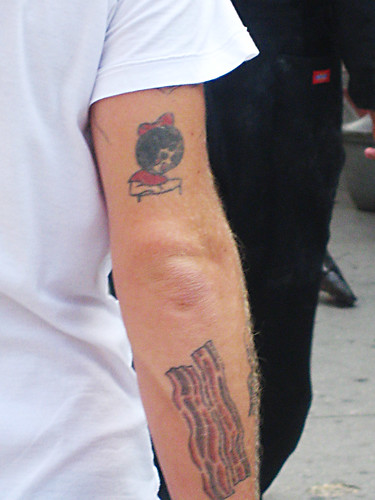
I love this. I spotted it via the Chelsea pool on flickr. shoehorn99 is one of the contributors.
I love this. I spotted it via the Chelsea pool on flickr. shoehorn99 is one of the contributors.

David Newton
Found Space, 2005
Found object suspended in steel form, held in place by wires, on top of geometric wooden form
77”H X 22”W X 33”D
David Newton is an Assistant Professor of Sculpture at Guilford College, Greensboro, NC. He is also the latest ArtCat artist, having found us via Emily Noelle Lambert. I love this sentence from his statement:
The sculptures sometimes include wheels, which highlights the tragicomic reality that most of us are rolling around, trying to keep it together.
Check out his new site for more information.
It appears to me that this is another Duke Riley “event”. See my earlier post for more information and compare these photos. The first is from flickr, the second is from WABC.


Manuela Leal
Kalashnikov Close-Up, 2007
58 × 78 Inches (4 parts)
I haven’t seen this work in person. I saw it on Manuela Leal’s RSS feed for her website. Yes, I still actually follow via RSS every artist on ArtCat. I have emailed with her about this series of work in the past, and learned a few things about where these come from.
These are color pencil and spray paint on inkjet prints. The images come from various war-related foreign videos on YouTube. I watch the videos and take stills from the computer screen with a digital camera. I then print the images, have layers of spray paint and then color pencils on top… I have been interested in war images and in “rebuilding” images of war and bombed, decimated buildings and places for a while now…</p>On YouTube, these videos are often posted as “responses” to other videos, as “justifications” (i.e.: a documentary on Croatian concentration camps will be posted in response to a serbian nationalistic video, and a video of a foreign mujahideen on the side of Bosnians torturing Serbian soldiers will be posted in response to a video on the massacre of Bosnians in Srebrenica by Serbs…).
I recognize that detached from language (they are often in languages I cannot understand), these images of war (and often propaganda) are posted, watched and commented on by people to whom images still carry immense urgency and power – they need to be seen…
I would like to know if" art" could still envision another reality, if by “altering” images one can offer the possibility – even if fictional – of change…</blockquote>
If I could believe that going to a barricade would affect man’s fate in the slightest I would go to that barricade, and quite often I wish that I could, but it would be less than honest to say that I expect to happen upon such a happy ending.
Joan Didion, Morning After The Sixties, 1970
I just finished reading The White Album by Joan Didion. I have read a couple of other books of her essays, and of course I read everything she writes for the New York Review of Books.


