bloggy

Michael Rakowitz - Taking back the streets

Michael Rakowitz - P(LOT)

This is great. I’ve always been amazed by the idea of free street parking in New York, especially in Manhattan, given the fact that a single space would be worth $1000 or more per month if it was part of an apartment, to say nothing of what decent storage space costs.

Michael Rakowitz has an interesting project, titled P(LOT), meant as a commentary on the use of public space for storing private vehicles.

Found via we make money not art. They have more information on their site. The artist’s web site is not set up for easy bookmarking to an individual project. I first heard of Mr. Rakowitz at White Columns, when I saw documentation of his paraSITE project involving portable and temporary shelters for homeless people.

Linkage

Some recent reading highlights:

  • Tyler Green’s series on Dada: 1, 2, 3, 4, 5 — I really appreciate the fact that he writes about Dada as a response to the horrors of World War I, and not just some silly nihilistic behavior by a bunch of crazy artists.
  • Speaking of Ashes on differing ideas of “the public” and its relationship to government and authority in Mexico and the U.S.

A good companion CD to Tyler’s essays would be Futurpiano, featuring music of that era by Lourie, Ornstein, and Antheil. Unfortunately, it appears to be out of print and is therefore a bit expensive.

Three years ago, I wrote two posts (1, 2) about a theater piece set in this post-WWI period called Blue Flower. There is even one scene set in the Cabaret Voltaire. The latest project by the same people is called Dagmar. Check out the web site for future concerts / appearances.

Updated: I added Tyler’s latest post.

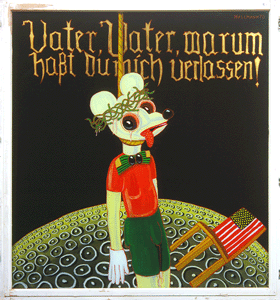
Carry Moyer on Blalla W. Hallmann at Thomas Erben

hallman.gif

Blalla W. Hallmann, Vater, Vater, warum haßt Du mich verlassen! (Father, Father, why Hate You Forsaken Me!) 1990, acrylic on glass, 120 × 110 cm.

The show already closed, but Carrie Moyer’s review of it in Gay City News is too good not to link. Here is my favorite part:

Rooted in folk art, reverse painting on glass is a poor man’s stained glass. The process flattens an image, pressing it up against the surface while the viewer’s reflection places her within the picture plane. Hallmann’s pictures are further simplified by the repeated use of forced perspective, bright cartoon color and black grounds, giving his work a ferocity and directness. Hallmann’s self-conscious adoption of various outsider and folk genres is particularly resonant at this moment when the “untrained” aesthetic favored by so many contemporary, academically-trained painters has come to represent a fetishized sign for authenticity.

Hallmann’s paintings make one realize how stealthy and insidious the taint of self-censorship is. Given the current state of global affairs, one might rightfully expect more visual bile and outrage to emanate from America’s art studios. Yet the art world’s cozy relationship with the political left looks polite, self-serving, and parochial next to Hallmann’s rude declarations.

Note: That’s not a typo above in the work’s title. He used puns and other purposeful “mistakes” in his titles.

William Powhida in Seattle

Medium NYC has a post on William Powhida’s show at Platform Gallery in Seattle. Check it out.

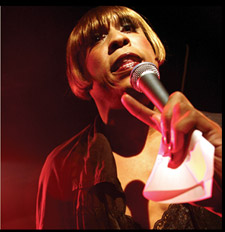
Here is a detail photo I took of his wall piece at Schroeder Romero / Plus Ultra:

William Powhida at Schroeder Romero/Plus Ultra Project Space

Echo Eggebrecht at Sixspace in Los Angeles

I am a fan of Echo Eggebrecht’s work, as I have written before.

She has a solo show at Sixspace in Los Angeles, opening Saturday. The new work represents an interesting (and I mean that in a good way) evolution from her solo show I saw here at Sixtyseven.

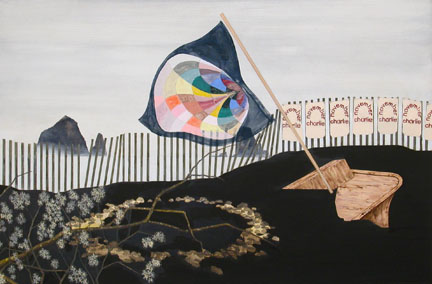
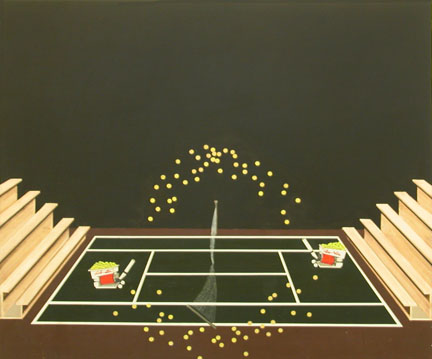
Here are a couple of images from the new show. Visit the gallery’s web site for more information and images.

echo-novembercharlie.jpg

November Charlie, 2006
Acrylic on panel
24 × 36 in.

echo-riptide.jpg

Riptide, 2006
Acrylic on panel
30 × 36 in.