Why the Democrats are wrong about Iraq
Go read Steve Gilliard’s post on the subject.
Go read Steve Gilliard’s post on the subject.
Newsday has a nice essay today by Matthew Shenoda on Arab culture and literature. An excerpt:
A survey of any of the major forces in contemporary Arab literature teaches us that while U.S. media have painted Arabs as villains of humanity, the truth is that dignity and a connection to place are central to Arab identity. We learn that the preservation of a peaceful life in one’s home is a major theme in Arab literature. We learn that resistance as an innate part of people who deeply love their home and their humanity comes second to a celebration of life. We learn a reverence for nature.
In the midst of the horror of a U.S.-led war, we can look to Iraqi poet Saadi Youssef to understand that in his Basra, a child learns, “that when rain falls in mist/there will be no lightning at the end/of the horizon,/no thunder in the heart,/no wave on the river.” Is this child now grown to be a “thug,” as Rumsfeld claims, or is he a person yearning to reconnect with his land, to provide a place for his family to live and grow, a place in which to gaze out on a horizon that will not be dotted by missiles?
In Darwish’s monumental memoir “Memory of Forgetfulness,” which chronicles his experience being exiled in Beirut during the 1982 war, he writes, “They can aim sea, sky, and earth at me, but they cannot root the aroma of coffee out of me.” Here we see coffee being used as an ancient symbol with roots in Abyssinia and Arabia to reflect a part of the very being of Darwish, a symbol rooted in the land, an aroma that cannot be erased by any amount of force.
Syrian poet Adonis, too, speaks of his connections to place in his poem “Remembering the First Century,” when he writes, “A mountain speaks its name/to me./ After all, I have/some credentials.” His credentials are roots tracing back beyond written record – his credentials are centuries of lineage in that place.
What many citizens of the United States do not have the opportunity to witness is the beauty of the Arab world, the way olive groves grace the landscape, the way children sit at the feet of their grandmothers, the way an ancient way of life has survived despite centuries of foreign occupation. And so perhaps the greatest understanding is for the people of the United States to see that Arabs are an ancient people, that the bombs over Iraq and the siege of Palestine are seeking to wipe out memory, the memory of history, of ancient and revered places, places we are all in some ways linked to.
Perhaps we need to learn that if we wipe out and erase Iraq and Palestine, we will, as Qabbani has learned, see that we are striking out half our own lives. Think of the beauty, as Darwish does, next time you smell the aroma of coffee.
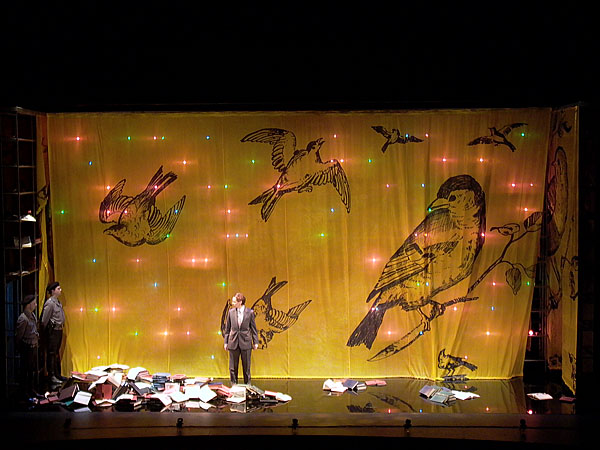
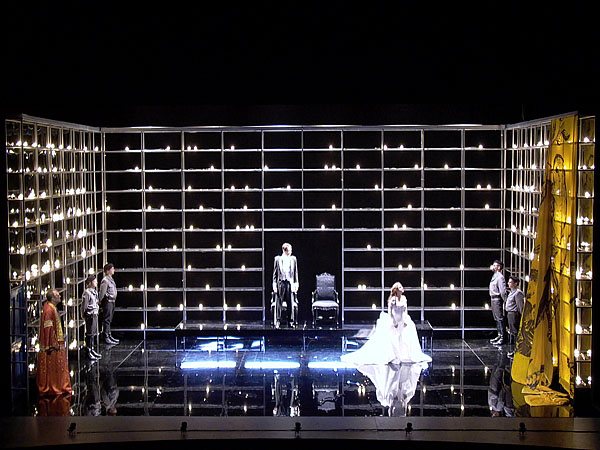
Handel’s Tamerlano at 2003 Spoleto Festival U.S.A.
photos by Lenore Doxsee
Our good friend David Zinn, costume and set designer extraordinaire, has a new web site. We first saw his work as a little baby designer with Target Margin, with whom he continues to work, in addition to more famous venues such as New York City Opera and Santa Fe Opera.
When we saw his Flavio at New York City Opera, the audience applauded the set changes.
Tamerlano is an opera by Handel loosely based on the life of Timur, a conqueror and ruler in 14th century Central Asia. Suitably for an opera set in that region of the world, being produced last summer at an American music festival, David didn’t ignore what was going on at the time.
In Handel’s rarely mounted Tamerlano, the defeated Bajazet…wore traditional sultan’s robes, while his corporate conquerors, barking orders and gleefully dividing the spoils, sported snazzy business suits. Mixing sexual and power politics, the libretto is nearly incomprehensible, but its centre—Bajazet losing his culture, his dignity and his daughter—is tragically clear. David Zinn’s cunning set was littered with ancient books and other looted treasures at the front of the stage, and endless, empty bookshelves at the rear.
— Jack Sullivan, Opera Magazine
Head over to James‘s site. He just put up several posts on recent art we’ve seen, with images.
Culturebot.org has an interview with the brilliant Deb Margolin. Her wondeful book “Of All The Nerve” is really expensive, since it’s from an academic press. Go see if Powell’s has a used copy.
She will be doing work from her new “performance novel” as part of the Dixon Place Veterans Series in May and early June. I recommend going!
A sample:
Q: When is solo performance effective and when is it self indulgent?
Self-indulgence… I’m very careful about that word because I feel like that’s a word we can use to shut ourselves down. That’s the word that the inner critic uses. Sentimental that’s another one, see there is no art without sentiment. As soon as you can drop down and reveal something about your own humanity, the minute you reveal something truthful about your own humanity, you shed light on the entire spectrum of human experience. That’s why we go to the theater for the revelation, that’s why I go. I go to stare at people!
You can’t do it in the subway you can’t do it on a bus. You go to the theater, you pay your money and you just stare at these people. That’s what you do and no one is going to arrest you. It’s very exciting. The more specific you are with your character the more generally we see the whole human condition. And so I feel the only way to get at that could be labeled, in advance of finding the jewel of revelation, self indulgent.
I don’t worry about self indulgence. I don’t worry that my work is self indulgent. I feel the need to step up and take responsibility for how my work signifies politically and I feel the need to be responsible for a passionate and articulate desire to speak. Those are my responsibilities. I don’t say anything that I’m not dying to say onstage. I say the things that I cannot die without having spoken about. And you know, that’s going to reveal something weird about my humanity and in so doing it will reveal something about the entire human condition. I trust that chain of events the way I trust I’m wearing this jacket. I know that to be true I know very few things and that’s one of them. So I live my artistic life by that principle. I’m not afraid of self indulgence as long as I am passionate to speak. I know that I will be revealing something important about humanity through my own humanity. Once you find your passion for speech, and your prerogative to speak, you are unstoppable.
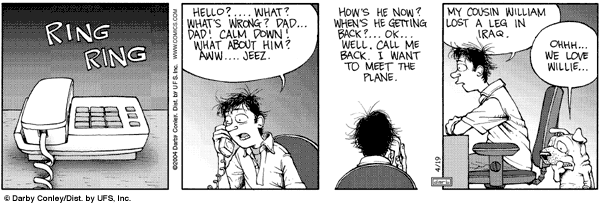
Even the comics I read for fun are getting political.
Remember when I wrote about how Jay Blotcher can’t be a stringer for the NY Times because he did media relations with ACT UP over ten years ago?
One would hope that the National Lesbian and Gay Journalists Association would be concerned about such things. You would be wrong, at least in terms of them being on the right side of the issue. As Jay tells us:
The National Lesbian and Gay Journalists Association has barred me from appearing at their Plenary on Journalistic Objectivity, scheduled at the June Convention in NYC.
The plenary session was created and organized by CNN journalist Rose Arce.
A month ago, Rose invited me to sit on this panel. She felt my case strongly reflected the current debate over journalistic objectivity. She plans to have the two SF Chronicle lesbian journalists on the panel, who were reassigned from the gay marriage beat after becoming hitched.
However, when Rose gave her list of panelists to NLGJA’s Executive Committee, she was told I could not sit on the panel.
Why? NLGJA felt my problem with the NY Times was a “personnel matter” between employer and employee … and NOT an issue of journalistic ethics. This was the same reasoning they gave me in March, when they refused to support my case.
Note that the NLGJA thinks it was wrong for the San Francisco Chronicle to prevent two lesbian reporters from covering gay marriage after they got married.
I guess it’s only things related to AIDS that the NLGJA considers mere “personnel matters.”
Revolting.
Openings we’re going to tomorrow:
Eyewash @ Boreas – group show that includes Joan Linder
Jennifer Dalton at Plus Ultra
Tim Laun at Parker’s Box
Yun-Fei Ji at Pierogi 2000
Eve Sussman at Roebling Hall
Let’s have a holy war!
If churches want to engage in politics, they need to be taxed just like everyone else. In Michigan, Catholics think doctors should have the right to refuse treatment to gay people if they don’t approve of their “lifestyle.”
Can you believe the Bush administration is actually talking about giving these people more tax dollars than they already receive? Where is my “I’m gay” checkoff box on my tax return to object?
Doctors or other health care providers could not be disciplined or sued if they refuse to treat gay patients under legislation passed Wednesday by the Michigan House.
The bill allows health care workers to refuse service to anyone on moral, ethical or religious grounds.
The Republican dominated House passed the measure as dozens of Catholics looked on from the gallery. The Michigan Catholic Conference, which pushed for the bills, hosted a legislative day for Catholics on Wednesday at the state Capitol.
…
Paul A. Long, vice president for public policy for the Michigan Catholic Conference, said the bills promote the constitutional right to religious freedom.
“Individual and institutional health care providers can and should maintain their mission and their services without compromising faith-based teaching,” he said in a written statement.
And people wonder why I won’t set foot in a Catholic church for a wedding or funeral?!