bloggy

A police state won't protect us

Bush went to Buffalo yesterday to promote the Patriot Act. He chose it because it was the location of the prosecution of the “Lackawanna Six,” but that’s not a case that provides a convincing argument.

Even now, after the arrests and the anger and the world media spotlight, the mystery for neighbors in this old steel town remains this: Why would six of their young men so readily agree to plead guilty to terror charges, accepting long prison terms far from home?


But defense attorneys say the answer is straightforward: The federal government implicitly threatened to toss the defendants into a secret military prison without trial, where they could languish indefinitely without access to courts or lawyers.

That prospect terrified the men. They accepted prison terms of 61/2 to 9 years.

“We had to worry about the defendants being whisked out of the courtroom and declared enemy combatants if the case started going well for us,” said attorney Patrick J. Brown, who defended one of the accused. “So we just ran up the white flag and folded. Most of us wish we’d never been associated with this case.”

The Lackawanna case illustrates how the post-Sept. 11, 2001, legal landscape tilts heavily toward the prosecution, government critics contend. Future defendants in terror cases could face the same choice: Plead guilty or face the possibility of indefinite imprisonment or even the death penalty. That troubles defense attorneys and some legal scholars, not least because prosecutors never offered evidence that the Lackawanna defendants intended to commit an act of terrorism.

I bring this up because of the suicide car bomber in Riyadh today.

A suicide car bomber destroyed a Saudi security forces building in the capital Wednesday, killing a senior officer and at least nine other people.

Medical and security sources in Riyadh said more than 60 people were wounded in what an official said was the sixth attempt to mount such a “terrorist attack” in a week. Five others had been foiled.

The blast, which coincided with a visit to the city by a top U.S. official, tore the front off the six-storey administrative block. Saudi television showed uniformed security force personnel in hospital and said some children were also injured.

The kingdom, a key U.S. ally and the world’s largest oil exporter, is battling a tide of Islamist militancy linked to Saudi-born Osama bin Laden’s al Qaeda network, which Washington accuses of the Sept. 11, 2001, attacks on U.S. cities.

Last year, suicide bombs killed 50 people in Riyadh.

If a police state like Saudi Arabia can’t prevent attacks with such tactics, what makes people think curtailing our liberties will make us safer?
Art Linkage

James and I went to the “new and improved” Brooklyn Museum on Sunday. I don’t know if I like the new glass entrance, but I wasn’t totally offended by it either. The vibe was so good, with all kinds of people you might not always see at a museum, it was hard to be grumpy. I really enjoyed the Open House: Working in Brooklyn show. Because the variety of artists working in Brooklyn is so large, in a way it felt more diverse than the Whitney Biennial. It was fun to see all kinds of people walking through that show and commenting on the contempary work. Where else would I see an Orthodox Jewish family with kids watching an Anthony Goicolea video? While you’re there, don’t miss the Patrick Kelly show either. I loved it. I hadn’t realized Bette Davis had been such a fan of his.

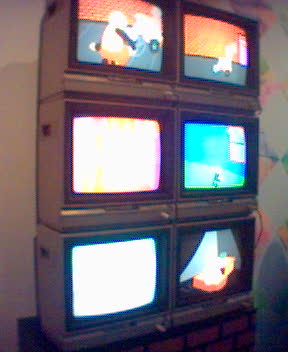
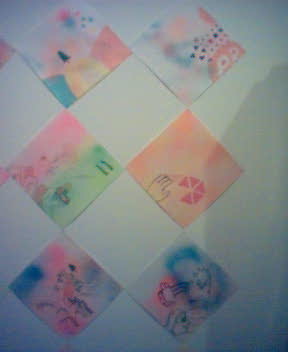
Tom Moody wrote about the Paper Rad show. Go read him.

Carlos de Villasante organized a show in Miami that looks great. Franklin has photos.

Good stuff

We saw two shows worth recommending in Chelsea today, before heading to the Paper Rad opening — which is definitely recommended!

The first is Paper Chase at Axel Raben, curated by Renee Riccardo. Jon Rosenbaum’s little paper sculptures are magnificent, as are many other works in the show.

The second is Joseph Maida at Wallspace. We realized after looking at his web site that we had seen one of his park images in a group show at the gallery. Also, he did the photo of Christian Holstad that appeared in the New York Times Magazine last October.

Pool Art Addict: A New York Underground Art Fair

Cool. A small art fair in a small new hotel (a Sheraton Four Points!) in Chelsea.

Pool Art Addict, May 13-16, see the web site.

Pool Art Addict: A New York Underground Art Fair, May 13-16, 2004, is set to premiere at the new Four Points Hotel, a needle-thin 22-story structure that went up last fall on a former parking lot at 160 West 25th Street in Manhattan’s Chelsea district. The fair is organized by Frére Independent (headed by Thierry Alet, an artist and co-founder of NYArts Magazine), which has taken the top four floors of the hotel and lined up 20 independent exhibitors. Designed to bring little-known artists to public attention during the spring contemporary art auctions, Pool Art Addict includes exhibitors such as the Nigerian Embassy, which is showing works by Ibiyinka Olufemi Alao; curator Amy Davila, who has organized an installation by Emily Lutzker; Le Triage Art Center from Paris, which is sponsoring Florent Mattei; and the Art & Culture/Anne-Marie Melster Gallery from Germany. General admission is $7; tickets to the opening night gala on May 13 are $30.

[via Artnet]

Last chance

Here is your “last chance” reminder on a couple of things.


civilians-gone-missung.jpg

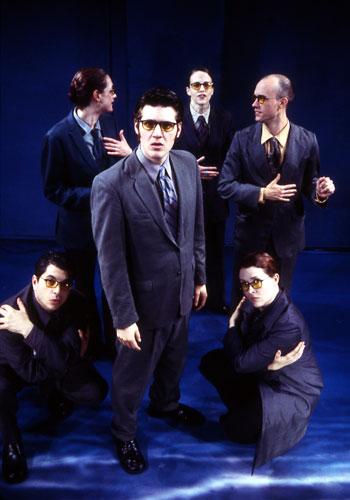
The Civilians: Gone Missing
(Back: Jennifer Morris, Maria Dizzia, Trey Lyford; Front: Damian Baldet, Michael Esper, Alison Weller)

First, think about joining us for The Civilians’ benefit on Friday in Chinatown. I already wrote about it here.


baran_kiss.jpg

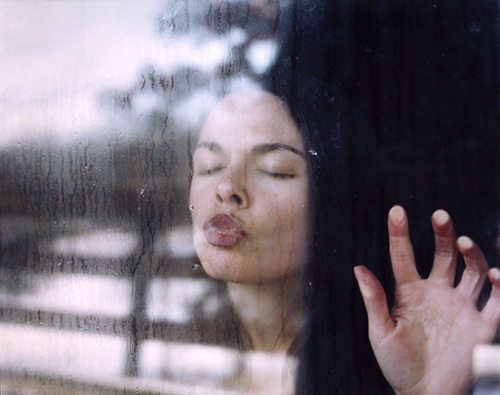
I Miss You Alreaday, 2004
Tracey Baran

Second, April 17 is the last day of Tracey Baran’s brilliant show at Leslie Tonkonow.

Mao's official photographers

hou_maobeach3.jpg
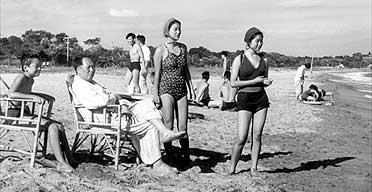
At ease: Hou Bo’s portrait of Mao and family at the seaside

When Mao Zedong proclaimed his new Socialist China in October 1949 from the great gate of Tiananmen, he walked to the balcony’s edge, looked over to the cheering crowds, and called out: “Long live the people!” Moments later, he was captured by the photographer Hou Bo, in that now-famous image, as he declared into the microphone: “The Chinese people have stood up.”

In the photograph, we don’t see the Chinese people themselves, listening in the square below. Mention of them – and even the greeting Mao had used – would soon become subversive. The next time Tiananmen Square would hear “Long live the people!” was 40 years later, when it was shouted by students calling for democracy, shortly before the tanks moved in.

The photograph of Mao on the balcony can now be seen in a fascinating and disturbing exhibition at the Photographers’ Gallery, London, that is largely devoted to the work of Hou Bo and Xu Xiaobing, the husband-and-wife team who became Mao’s official photographers.

19th Street assemblage

19th-street-assemblage.JPG

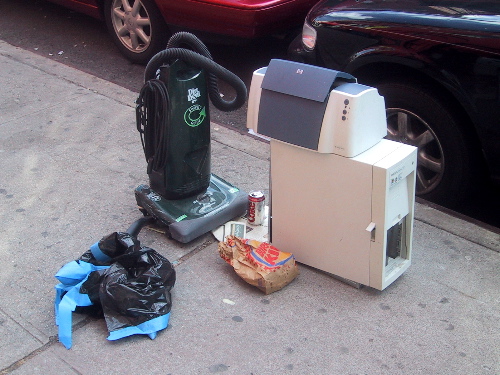
I think it’s just trash rather than a scatter art installation. As we walked by this someone was sitting nearby in his car, with the windows down, blasting Maria Callas singing Vissi d’arte (I have lived for art) from Tosca.

The malling of NYC continues

From Crain’s:

Ian Schrager’s Paramount Hotel, at 245 W. 46th St., will be bought by the Hard Rock Hotel chain for $125 million. The deal is expected to close in June.